
A new AI plugin lands on WordPress.org every 1.8 hours. In 2023, it was one every three days.
I got curious about this last week and decided to actually count. So I pulled a snapshot of the full plugin directory (all 68,651 currently listed plugins) and sorted out which ones are AI-related, using their tags and names. To be clear about what this is: a solid afternoon of counting against a public API, not a peer-reviewed census. The classification has edges, and the numbers are floors. But the trend is steep enough that no reasonable tweak to the method changes the shape of it.
Here’s what my analysis says. Method notes are at the end if you want to recount.
The headline numbers
- 3,163 AI plugins currently listed (a stricter cut says 3,012)
- 17.4% of everything added in 2026 is AI-related, about 1 in 6 new plugins
- 1,843 plugins have “AI” in their name
- A new AI plugin lands every 1.8 hours at July’s pace
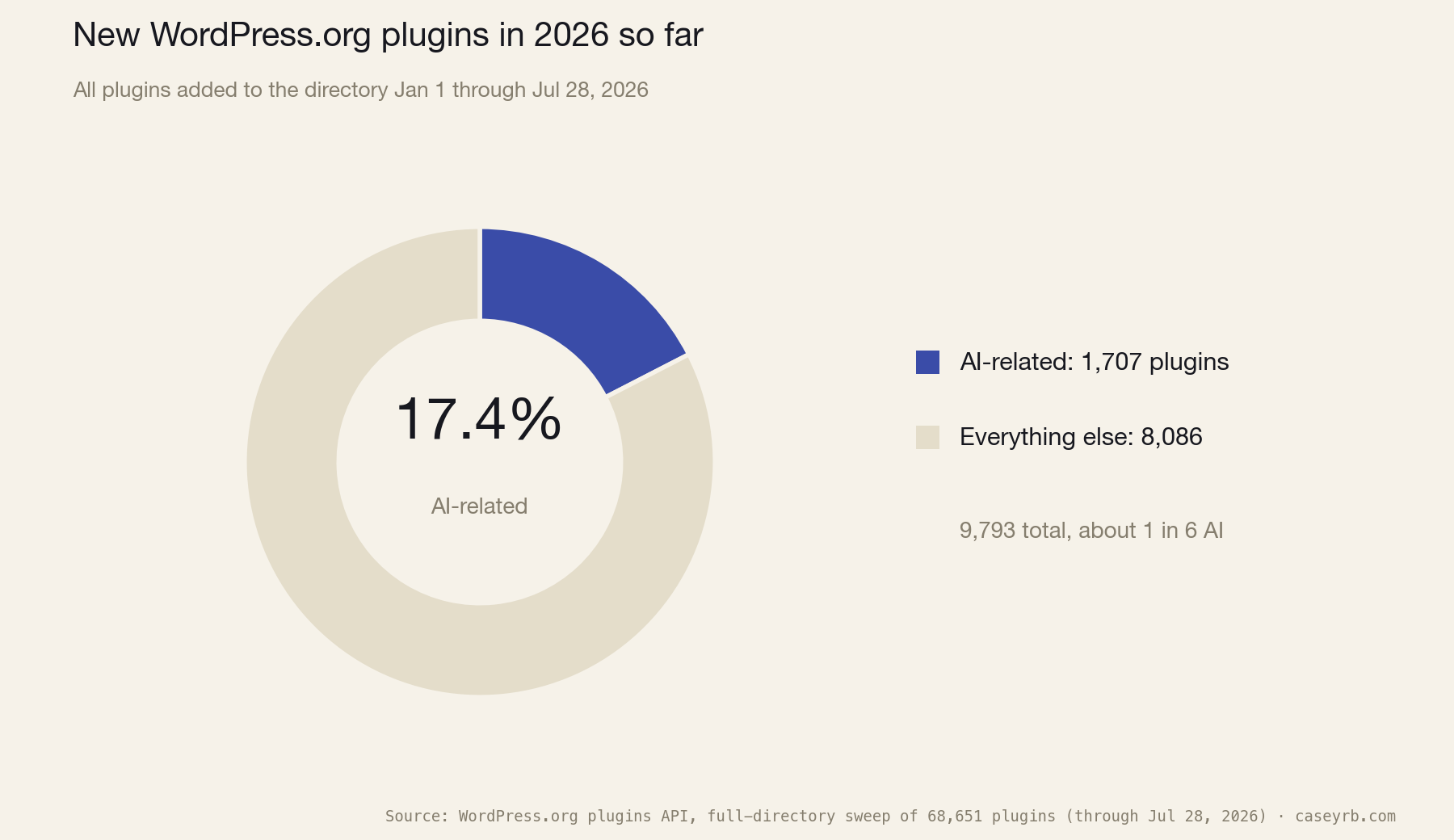
The count is the boring part, though. The interesting part is the direction.
The share climbs every year
Here’s the AI share of new plugin listings by year:
| Year | New plugins | AI | Share |
|---|---|---|---|
| 2021 | 3,495 | 35 | 1.0% |
| 2022 | 3,239 | 73 | 2.3% |
| 2023 | 1,871 | 136 | 7.3% |
| 2024 | 3,334 | 255 | 7.6% |
| 2025 | 6,050 | 727 | 12.0% |
| 2026 (through Jul 28) | 9,793 | 1,707 | 17.4% |
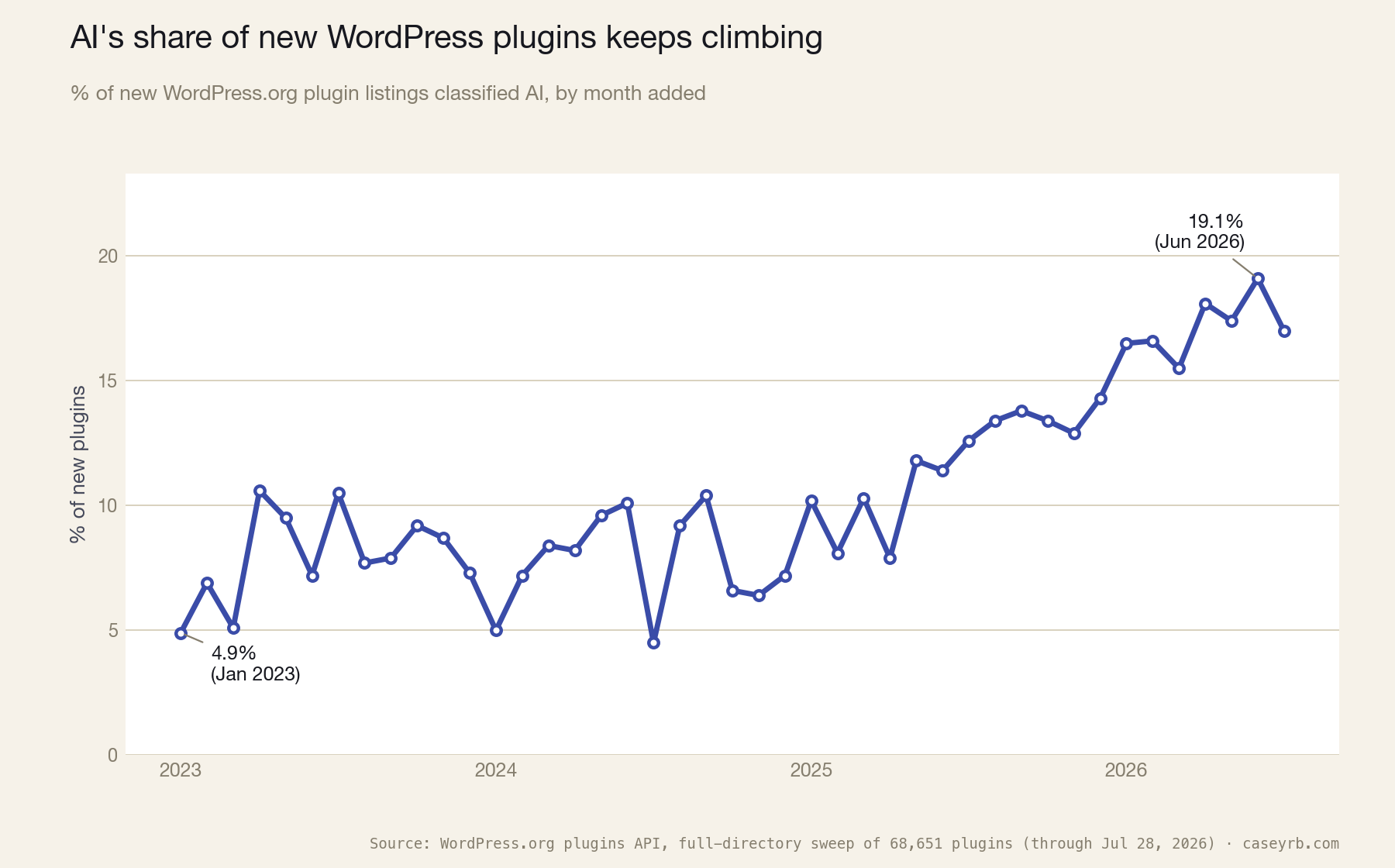
Recent months run between 15% and 19%. June 2026 peaked at 19.1%: of the 2,174 plugins added that month, 416 were AI.
The 2023 numbers deserve a footnote: ChatGPT’s API had just landed, and the directory’s total intake was at a low point that year, so the jump from 2.3% to 7.3% partly reflects a shrinking denominator. No such excuse exists for 2025 and 2026. Total additions exploded and the AI share kept climbing anyway.
The acceleration is the real story
Cumulative milestones make the curve visceral:
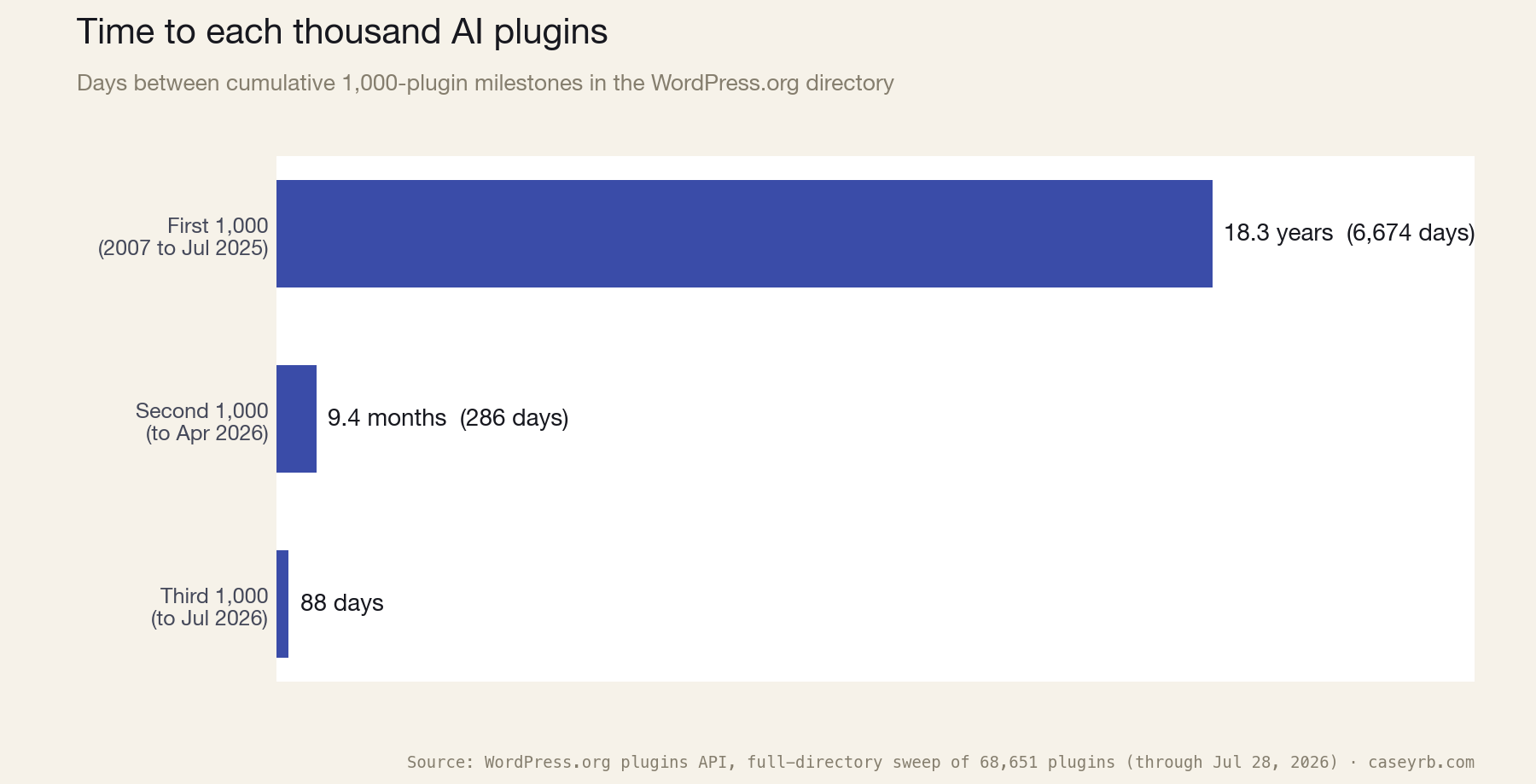
It took 18.3 years for WordPress.org to accumulate its first 1,000 AI plugins. The second 1,000 took 9.4 months. The third took 88 days.
A few more numbers from the sweep:
- Two-thirds of all AI plugins ever listed arrived in the last 12 months (2,122 of 3,163).
- The last four months alone (1,279) produced more AI plugins than 2023, 2024, and 2025 combined (1,118).
- June 2026 by itself (416) nearly matched the entire AI catalog as it stood at the end of 2023 (474).
- July additions are up 6.4x year over year (59 last July, 377 so far this one).
- It’s not just AI: July 2026 is already the biggest month in directory history for total plugin additions (2,217 through the 28th, beating June’s 2,174), with three days to spare. The whole intake pipeline is accelerating; AI is just accelerating faster.
- The agentic layer is brand new: 78 of the 92 plugins tagged
mcpwere added this year, and 98 of 117 taggedllms-txt. That matches what I found when I measured llms.txt adoption across the wider web: this stuff barely existed before 2026.
What kinds of AI plugins are these?
Tags can answer this too, with a caveat: plugins carry several tags, so categories overlap (a WooCommerce chatbot counts under both “Chatbots & assistants” and “Ecommerce & products”), and the shares below deliberately don’t sum to 100%. Read this as “what plugin authors say they built”:
| Type | Plugins | Share of AI plugins |
|---|---|---|
| Chatbots & assistants | 998 | 32% |
| SEO & search visibility | 794 | 25% |
| Content & writing | 720 | 23% |
| Ecommerce & products | 549 | 17% |
| Support & helpdesk | 433 | 14% |
| Agents & AI infrastructure | 356 | 11% |
| Images & media generation | 246 | 8% |
| Translation & language | 95 | 3% |
| Spam, security & moderation | 75 | 2% |
| Voice & speech | 70 | 2% |
| None of the above | 446 | 14% |
Chatbots are still the front door: a third of everything. But look at line six. Agents and AI infrastructure (MCP servers, llms.txt tooling, RAG and embeddings) is already 11% of the catalog, and as shown above, nearly all of it shipped this year. The “none of the above” row is my favorite: AI quiz makers, AI crawler blockers, AI dashboards, AI lead-capture tools. The long tail is doing its thing.
So when is every new plugin an AI plugin?
Obviously the honest answer is “never, exactly.” But the trend line is too tempting not to ride, so let’s ride it properly.
The first question is which curve to ride. I fitted both a straight line and an exponential to the recent monthly data. Slightly to my surprise, the straight line fits better (R² of 0.89 vs 0.85 over the last 18 months): the share has been climbing a steady half-point-ish per month, not compounding. But the exponential isn’t crazy either, and the gap between the two stories is the whole chart:
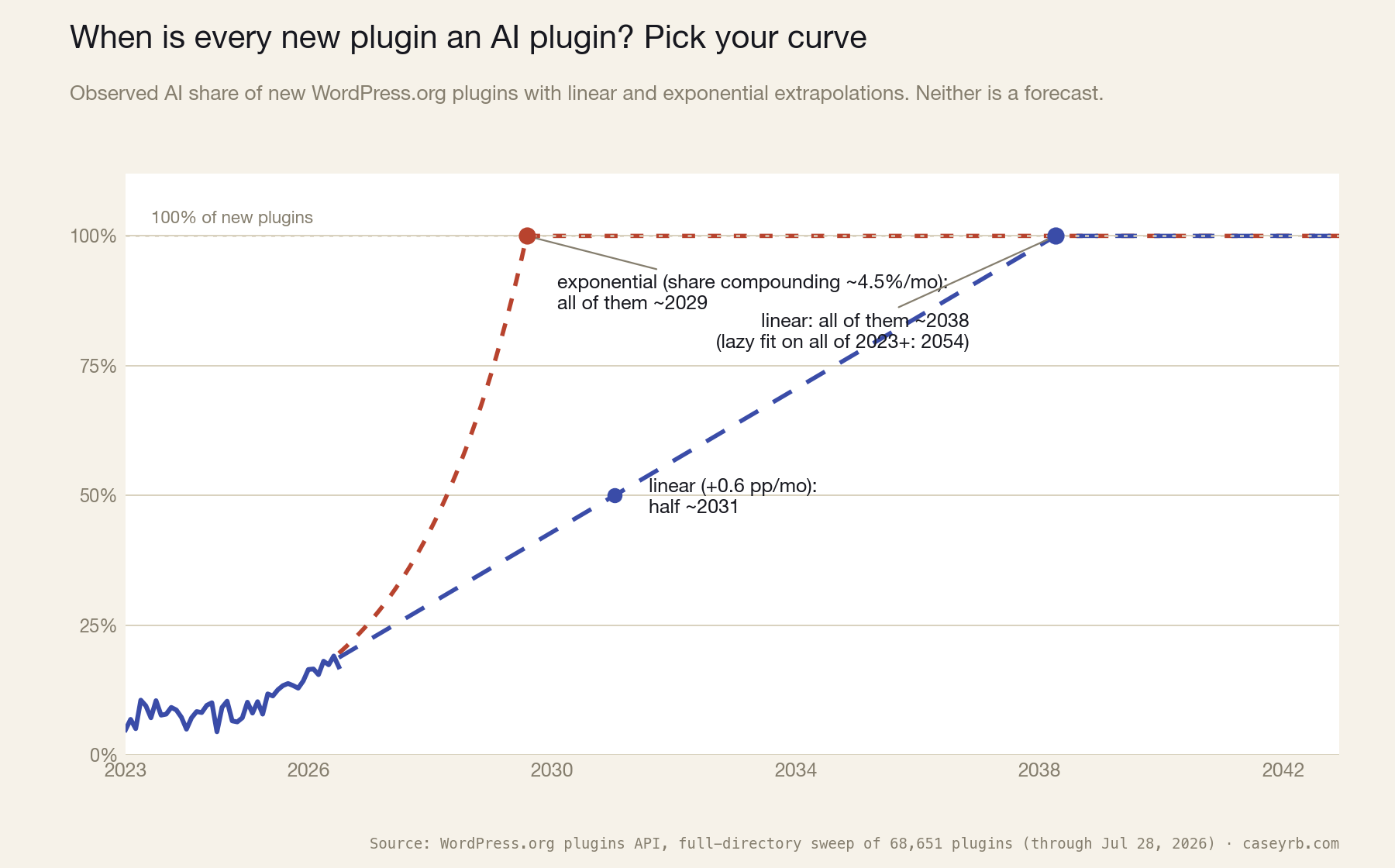
- Exponential (share compounding ~4.5% per month, doubling every 16 months): every new plugin is AI by late 2029.
- Linear (+0.6 points per month): half of all new plugins by 2031, all of them by 2038. Fit the line lazily on the full period since 2023 and it stretches to 2054.
- The principled model for a share that can’t exceed 100% is neither: it’s an S-curve. Fitted to the same data, it puts the midpoint around 2030 and 95% around 2038, which lands remarkably close to the straight line.
What I make of it
One in six new plugins being AI-related is a supply signal, not a quality signal. Nothing in this count tells you how many of these 3,163 plugins are good, maintained, or safe to run in production. My spot checks suggest plenty are thin wrappers around somebody’s API key. Discovery in the directory was already hard; it’s about to get much harder.
But the composition shift is real, and it’s compounding. The fastest-growing corners of the data (MCP servers, llms.txt generators, agent-readiness tooling) aren’t “AI features” at all. They’re infrastructure for software that talks to your website on your behalf. That’s a different thing than a content generator, and it’s the part I’d bet on. It’s also why I keep arguing that WordPress needs a mission for the agentic era: the directory is already voting with its feet.
I’ll re-run the count in a few months and we’ll see whether the line bent.
Method notes
For anyone who wants to recount (the whole pipeline is four small Python scripts against the public WordPress.org plugins API):
- One snapshot, the whole directory. I paged through the API’s “recently added” browse listing, which returns every listed plugin with its name, tags, and date added. That matters because the API’s search endpoint silently caps at 1,250 results, which is why most “how many AI plugins?” numbers you’ll see quoted are lowballs.
- Classification is tags and names. A plugin counts as AI if it carries one of 434 AI-related tags (matched by pattern across every tag in the directory, not hand-picked) or has “AI” as a word in its name. The stricter count (3,012) drops plugins whose only signal is a chatbot tag, because spot-checking showed those are mostly rule-based bots from the pre-LLM era.
- I spot-checked 37 classified plugins against their real descriptions. The false positives: two p5.js creative-coding plugins, one radio plugin tagged
gemini(the zodiac kind), and one calendar plugin whose name starts with “Ai1ec”. Four out of three thousand, excluded or immaterial. Every number above also survives the strict definition. - Known limits. The sweep only sees currently listed plugins, so delisted history is invisible (between two runs a day apart, 2024’s totals quietly shrank by two). Tags are today’s tags: the “oldest AI plugin” in the data is All in One SEO Pack, added 2007, because it wears an AI tag now. And a plugin that never says AI in its name or tags doesn’t get counted, so everything here is a floor. A full-text search for “AI” returns 4,911 matches, a loose ceiling that includes readme-only mentions.
That’s the nice thing about counting instead of vibing: anyone can recount.