
In July 2026, WordPress’s core team decided not to add a feature called wp_knowledge to the next release. Almost nobody noticed. It was a proposal to give WordPress a built-in place for AI to store knowledge and memories, right inside your site.
It got me thinking. I genuinely like the wp_knowledge idea, and I think some version of it lands in core eventually. But it also made me want to push the idea further. If WordPress can hold an AI’s knowledge, could it become the actual brain for my AI assistant?
Most AI memory systems today fall into one of two camps, and both have a flaw. Some are local markdown files: fine until you switch to another agent or another device, at which point the context is gone. Others are polished, cloud-based black boxes: they follow you everywhere, but you can’t easily see or edit what they’ve decided to remember about you.
Enter WordPress. It has neither problem. It’s already built for managing content, it has a front end you can actually look at, and it’s self-hosted and secure. And thanks to the new Abilities API and the MCP adapter (more on both shortly), you can reach it from any agent, on any device.
So I fired up Fable, Anthropic’s fast coding model, and put it to work building a small WordPress plugin. Half an hour later, I was convinced of two things: AI agents need a memory, and WordPress is a strangely good place to keep one.
The web is going agentic, and agents need memory
I’ve written before that the web is going agentic. More and more, the “visitor” doing something on a site is an AI agent acting on a person’s behalf: comparing options, booking a call, pulling an answer.
Here’s the catch with these agents. They’re brilliant, and they’re amnesiac.
Every time you open a fresh conversation with an AI assistant, it starts from zero. It doesn’t remember your preferences, the decisions you made last week, or the way you like things done. It’s like working with a genuinely talented new hire who forgets everything overnight and reintroduces themselves every morning.
The thing that makes an assistant actually useful isn’t raw intelligence. We have plenty of that now. It’s context: knowing who you are, what you care about, and what already happened.
That context has a name people are starting to use for AI. Memory. And memory has to live somewhere.
Memory is just content, and WordPress is very good at content
Here’s the reframe that made it click for me. A memory is just a small piece of content. A short, durable, searchable note. “Casey prefers this.” “We decided that on this project.” “Here’s how this thing works.”
And if memory is content, then the question of where to keep it has an answer nobody really talks about: WordPress.
WordPress runs about 33% of the web. It’s the most widely used content platform ever built. More to the point, it comes with everything a memory system needs, for free:
- A place to store notes.
- A friendly screen to read and edit them.
- Built-in accounts and permissions.
- Search.
- A standard way for other software to read and write that content.
- Self-hosted, secure, and extensible.
So instead of your AI’s memory being a hidden file that only one tool can see, it becomes real content. Something you can browse, search, and edit yourself, and that any AI agent can read from and add to.
What I actually built
I made a small WordPress plugin. It registers a custom post type called memory. Memories behave like any other post type: their own admin menu, their own list table, their own search, and a permalink for each one on the front end. Nothing exotic, just a new content type that happens to hold what my AI should remember.
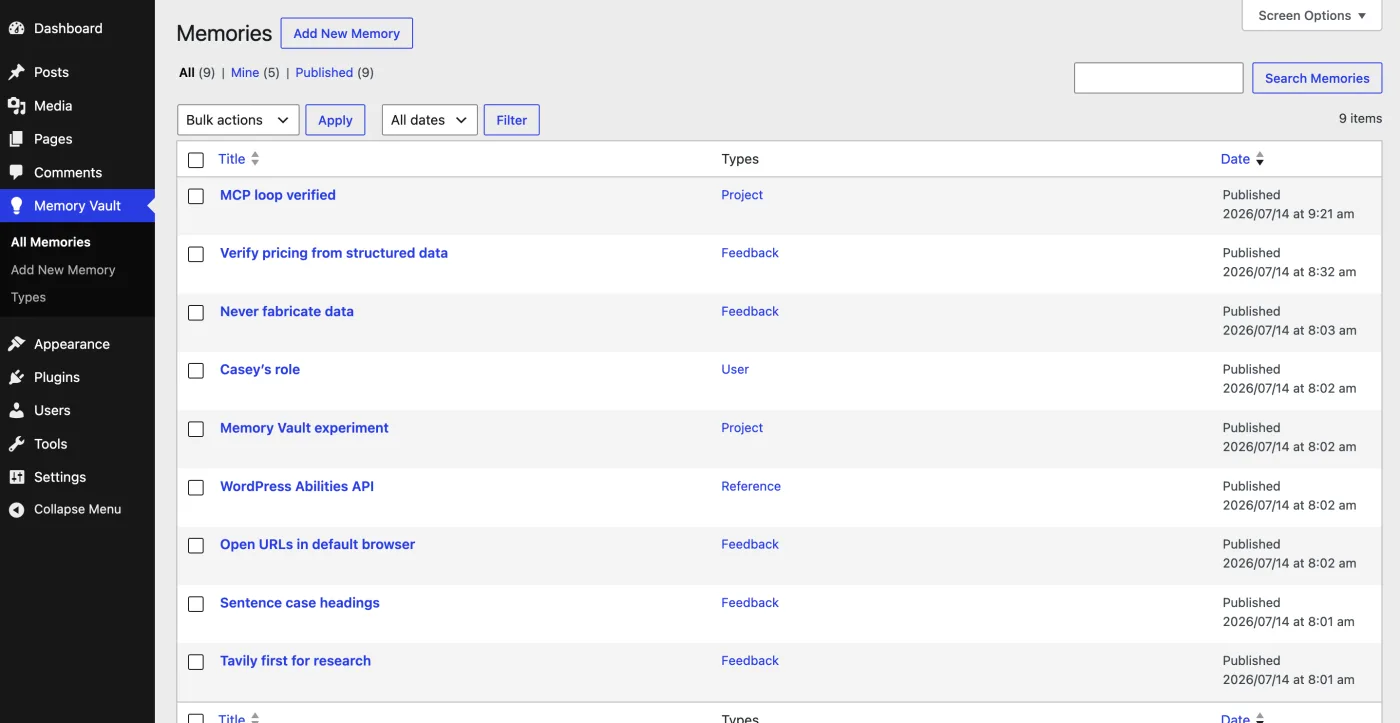
Each memory is a little note with three parts: a short title, a one-line summary, and a body written in plain markdown. Every note is tagged by type, whether it’s a fact about me, a preference, a project, or a reference. Editing one feels like writing a very short blog post.
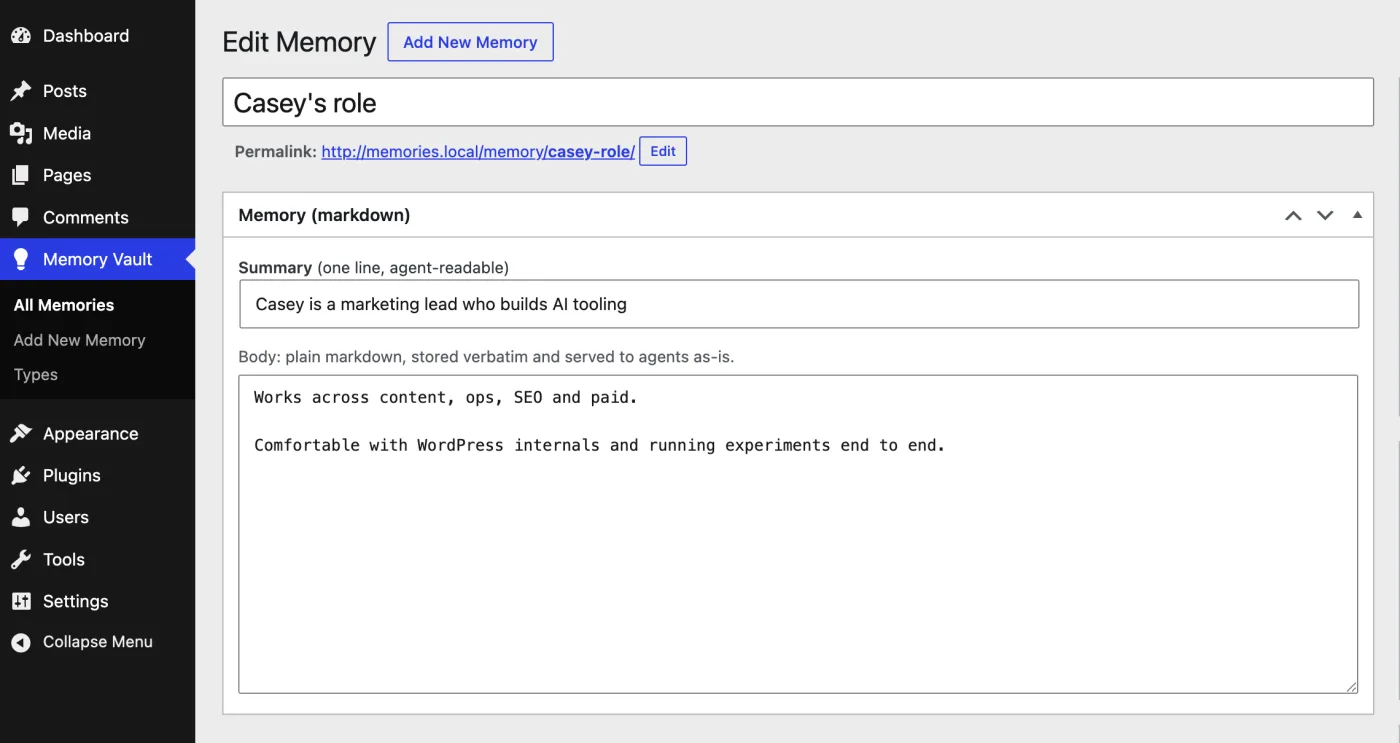
Because every memory is just normal WordPress content, it serves two audiences at once:
- For me, each memory is a page on the site, and I manage and search them in the admin the same way I’d manage blog posts.
- For an AI agent, those same memories are something it can look up and add to.
The bridge between the two is a piece of tech called MCP, the emerging standard that lets AI assistants plug into apps. I’ve called it the connective tissue for an AI assistant before. With MCP switched on, my assistant simply sees two new buttons it can press: “search my memory” and “save a memory.” (This is the same kind of wiring behind my autonomous marketing setup, just pointed at a different job.)
Then came the moment that made me grin. I asked my assistant to save something, and it wrote a note straight into my WordPress site. A second later, that memory was a normal page in my browser, one I could open, read, and edit. A memory an AI wrote, living on my own website.
There’s one catch worth naming, because it’s the interesting part. Giving an AI the ability to remember doesn’t mean it will. You still have to tell it when to look things up and when to save something new. That turns out to be a few plain-English rules, not code. And deciding what’s even worth remembering is still a judgment call. The store is the easy bit. The habit is the hard bit.
A bit more on the plumbing
If you’re curious how this works under the hood, here’s the short version.
A memory maps onto plain WordPress primitives. The title is the post title, the summary is the excerpt, and the markdown body is the post content. The type is a memory_type taxonomy. Everything else lives in post meta: freeform tags, a confidence score, a source, and a list of links to related memories. That last field is my favorite. Because memories can reference each other by slug, the vault quietly becomes a small graph, and each memory’s page shows what it links to.
WordPress 6.9 shipped the Abilities API, a standard way for a plugin to register discrete “abilities,” each one a named action the site can perform, with a description, the inputs it expects, and a permission check. My plugin registers four: recall a memory, save a memory, fetch one by name, and list them. That’s the whole memory interface, defined once.
The MCP adapter (another plugin, maintained by the WordPress project itself) does the clever part. It takes those registered abilities and publishes them as MCP tools at a single web address. My assistant connects to that address, signs in with an application password, and instantly sees the four memory tools it can call. When it calls “recall,” WordPress checks the permission, runs the search across my notes, and hands back a clean, structured result.
The neat thing is that I never really built an API. I described what the site could do, and the Abilities API plus the MCP adapter turned that description into something an AI can use. The same definition works whether the request comes from a browser or from an agent.
WordPress core almost shipped this exact idea
Which brings me back to wp_knowledge.
WordPress’s core AI team had proposed adding essentially the same thing to WordPress itself: a built-in store called wp_knowledge for guidelines, notes, and memories, designed to be read and written by AI agents. In other words, close to the plugin I’d just built, except proposed for the core of the software that runs a third of the web.
In July 2026, the core team decided not to put it in the next release. The gist of the pushback: this should prove itself as a plugin first, and maybe earn its way into core later. Some felt AI was pushing a feature into WordPress that most users hadn’t actually asked for.
The decision matters less than the fact that it was seriously on the table. WordPress core is starting to think of itself as a place where agents store and retrieve context, not only a place where humans publish posts. It’s an early step toward something bigger: WordPress becoming the operating system of the agentic web.
WordPress as the operating system for the agentic web
Step back and the threads connect.
Agents need memory and context. WordPress already holds a huge share of the world’s content, and it has the plumbing: accounts, permissions, and a standard way in and out. And core is quietly adding AI-native pieces. As of version 6.9 it ships the Abilities API that lets agents take real actions on a site, and it nearly shipped a memory store on top of it.
Automattic, the company behind WordPress.com, has been making exactly this case. A year ago I’d have called it a stretch. Now I’m less sure it is.
Picture where this goes. Your site stops being only a stack of pages for humans to read. It also becomes a set of things agents can do and a memory they can draw on. Your own assistant uses it. Maybe, eventually, other people’s assistants talk to it too, and your site gets a little delegate that answers for you when an AI comes knocking.
I’ve argued that WordPress needs a new purpose now that it’s more or less finished its original one of democratizing publishing. This might be it: giving ordinary people, not just the big AI labs, a place to own their AI’s memory and capabilities.
So, think about this
This was a half-hour experiment, and it’s not going anywhere near production. But it left me with a question I can’t shake.
If your AI assistant is only ever as good as what it remembers about you, where do you want those memories to live?