
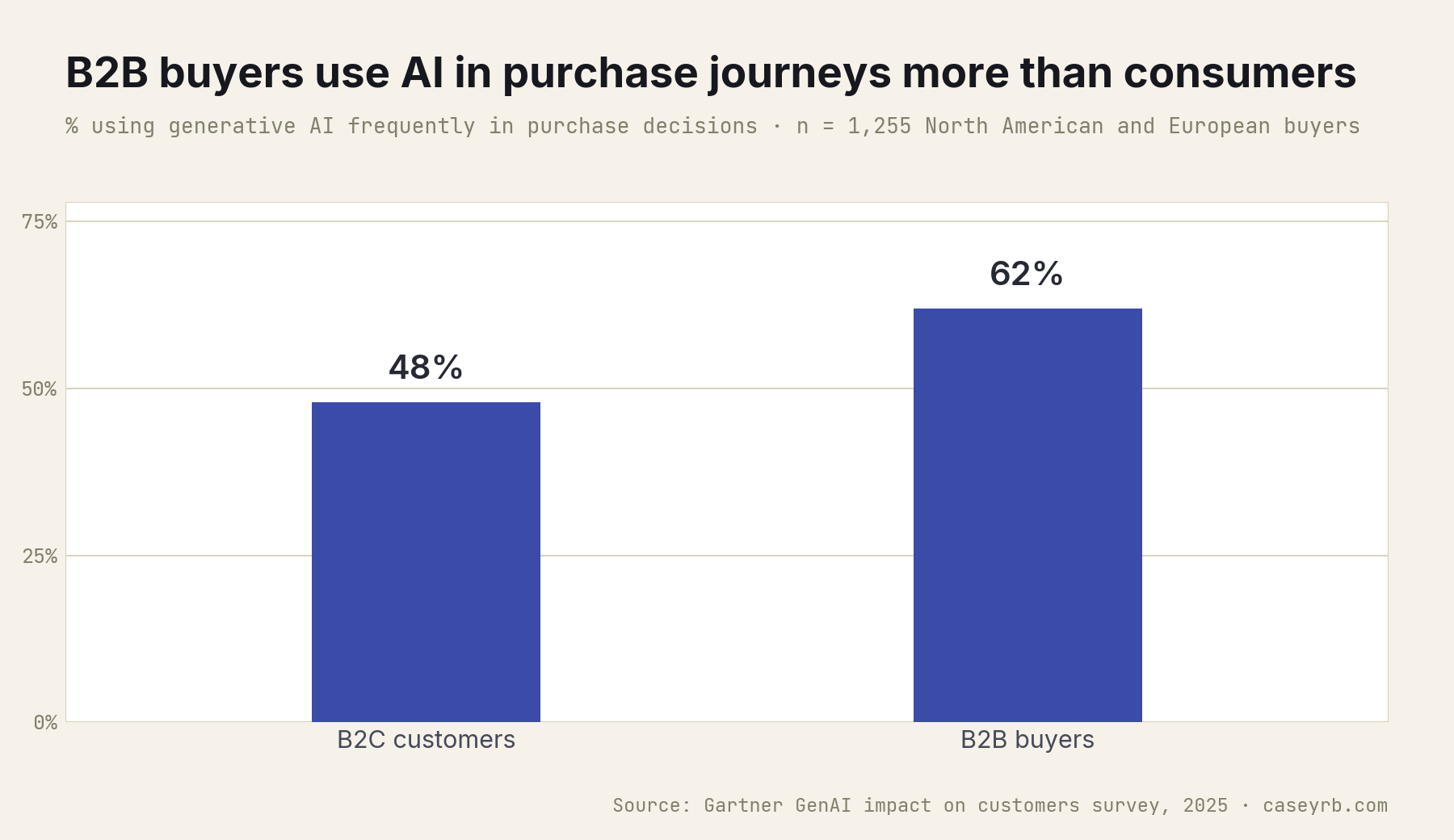
48% of consumers and 62% of B2B buyers now frequently use generative AI to help decide what to buy. Those numbers come from a survey of 1,255 buyers that Gartner analyst Matt Moorut presented in an August 2026 webinar on capturing customer attention in an AI-mediated world.
The rest of the webinar mapped out what follows from those numbers. The middle of the buying journey, the shortlisting and comparing, now happens inside AI tools that give marketers no data back, so attribution can’t see it. And most buyers lean on the AI harder than they should, which measurably hurts the quality of what they end up buying.
I sat through the whole thing so you don’t have to. Here’s what’s going on, and what you can do about it if you sell software.
B2B buyers got there first
The adoption numbers hide a surprise. Consumers usually adopt first and businesses follow. This time it’s inverted: B2B buyers are using AI in purchase journeys more than consumers are.
The mechanism is simple. Companies are handing employees enterprise AI subscriptions and encouraging usage, and those habits follow people into their personal buying. A complex B2B purchase also rewards an assistant far more than buying a pair of jeans does.
The stickiness data matters more than the adoption data, though. Around 70% of buyers in both groups told Gartner they use AI in purchase journeys because it makes the process easier and faster. Behavior that people find easier and faster doesn’t recede. It compounds.
Attribution went dark
Digital marketing was built on a flywheel of observation. Buyers did their researching and comparing on websites we owned or channels we could measure, so we could watch the behavior, optimize against it, attract more buyers, and observe again. Search terms, traffic sources, attribution models: all sensors pointed at the middle of the funnel.
That middle now increasingly happens inside ChatGPT, Gemini, Claude, and Copilot. And none of the model providers give you a backend. There is no console showing you what buyers asked, what the model answered, or whether you were mentioned. Gartner’s CMO clients describe it as a loss of control. One put it bluntly: “Previously, we could at least buy our way into visibility.”
I’ve written before about why marketers need systems thinking, and this is the clearest example I’ve seen in years. Marketing is a control system. Remove the feedback signal from a control system and it doesn’t just slow down, it drifts. You keep optimizing against the sensors you still have, which now measure a shrinking slice of reality, and you over-correct in the places you can see to compensate for the places you can’t.
Gartner puts 67% of marketing budgets in digital channels, with 15% already going specifically to AI. That’s a lot of spend steered by instruments that no longer see the road.
Now, some visibility can be recovered. I built a Looker Studio dashboard for tracking AI referral traffic that takes about five minutes to set up, and citation monitoring across the major answer engines is maturing quickly. But these are proxies. The honest position is that a growing share of your funnel is now unobservable, and your strategy needs to work under that assumption.
What the survey actually found
Gartner ran regression models against a specific outcome they call a high-quality purchase: the buyer bought what they intended or more, chose confidently, and felt no regret afterwards. If you run a retention business, that’s the only kind of purchase worth acquiring.
Three findings stood out:
- Buyers who engaged with brand-provided information were 88% more likely to make a high-quality purchase. That’s a huge effect, and it should kill the fear that brand content no longer matters.
- Buyers who used an independent AI tool were also more likely to make a high-quality purchase. Less than with brand content, but positive. AI-assisted buyers are better-informed buyers.
- Buyers who relied heavily on AI to make the decision for them were 29% less likely to make a high-quality purchase.
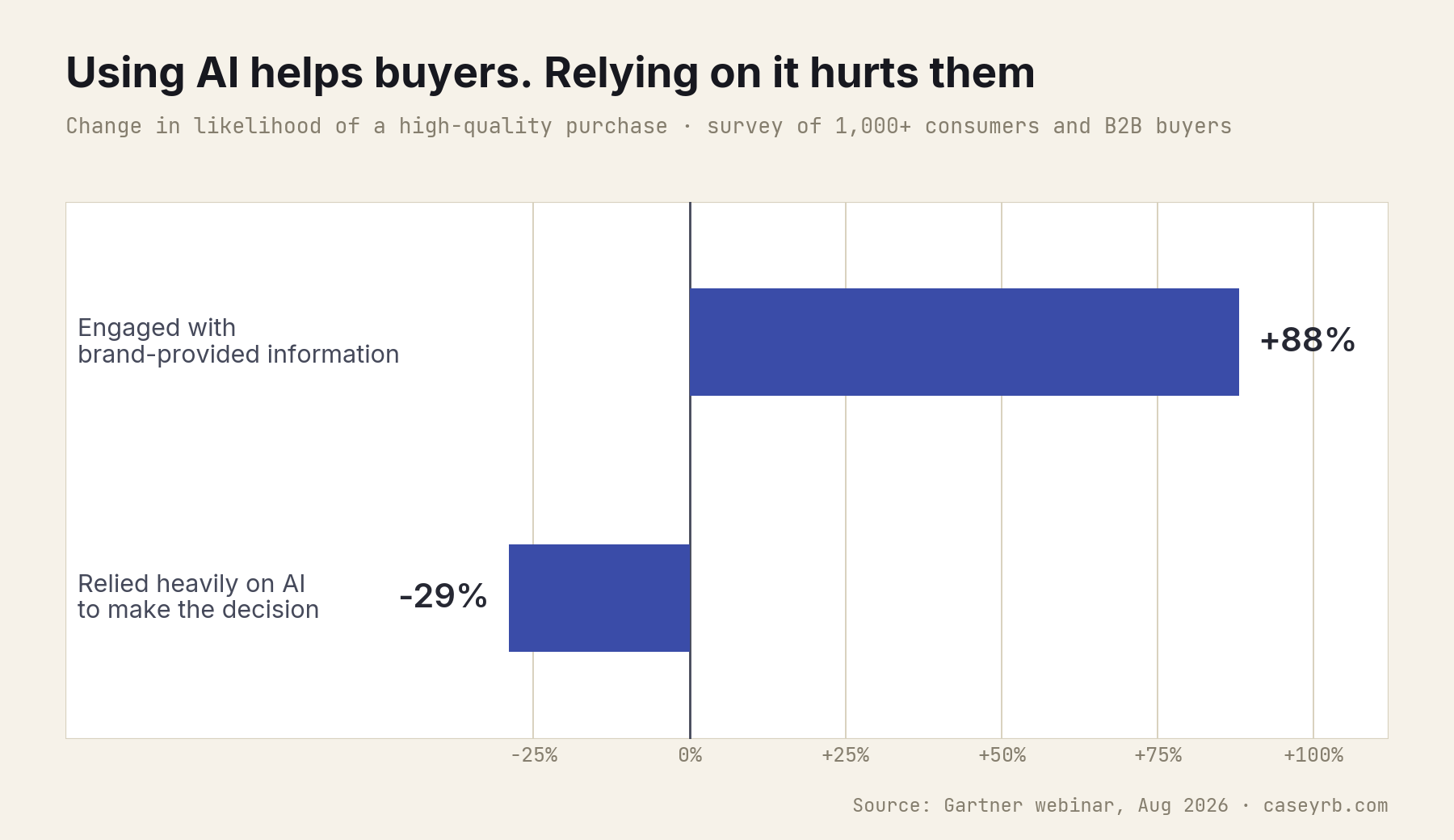
Here’s the thing those three findings add up to: usage is good, reliance is bad. A buyer who uses AI to get smarter makes better decisions. A buyer who delegates the decision to AI makes worse ones.
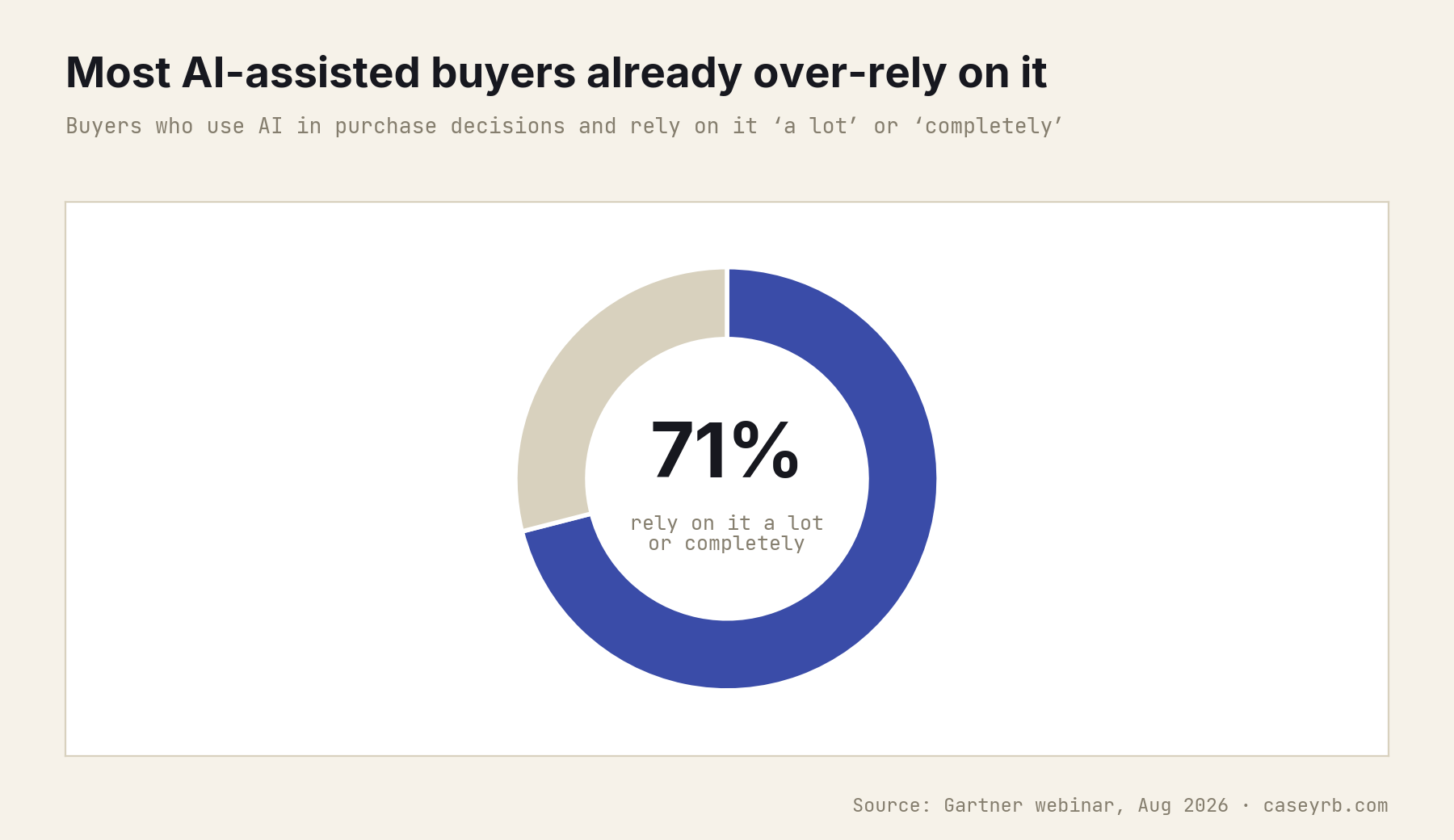
Now the uncomfortable part: Gartner found that 71% of buyers who use AI in purchase decisions already rely on it heavily or completely. The failure mode isn’t the exception. It’s the majority.
Your buyers trust it too much
Why does reliance produce bad purchases? Because answer engines fail in ways that are invisible to the person relying on them:
- They’re not domain experts. They do a convincing impression of one, which makes misdiagnosis more likely, not less.
- They have an affirmation bias. Ask “should I switch from my current provider?” and you’ll get encouragement to switch. Ask “why should I stay?” and you’ll get reasons to stay. The framing of the question smuggles in the answer.
- They don’t probe for context. A model will happily produce a confident shortlist without knowing your use case, your constraints, or your budget, unless you volunteer all of that unprompted.
- They skip steps. Return policies, compatibility checks, license terms. The boring diligence steps are exactly the ones that prevent purchase regret, and they’re exactly what a summarized answer omits.
If you sell software, this should worry you more than the visibility problem does. A reliance-driven purchase doesn’t fail at checkout. It fails three weeks later, when the product turns out not to fit the use case, and it surfaces in your metrics as a refund and a churn event. Bad-fit customers are expensive under any business model (I’ve written about what license fees are actually paying for). AI over-reliance is a machine for manufacturing them.
AI lives in the mid-funnel
Gartner also mapped where in the journey buyers actually use AI, and the answer is specific: the middle. Shortlisting options, learning about offerings, comparing alternatives. Usage drops off sharply at both ends. Discovery still happens across the usual channels, and completing a purchase still overwhelmingly happens on brand-owned platforms. Agentic commerce, where the AI buys on your behalf, barely registered in their data. I think that changes eventually. It just hasn’t yet, and strategy should follow the data.
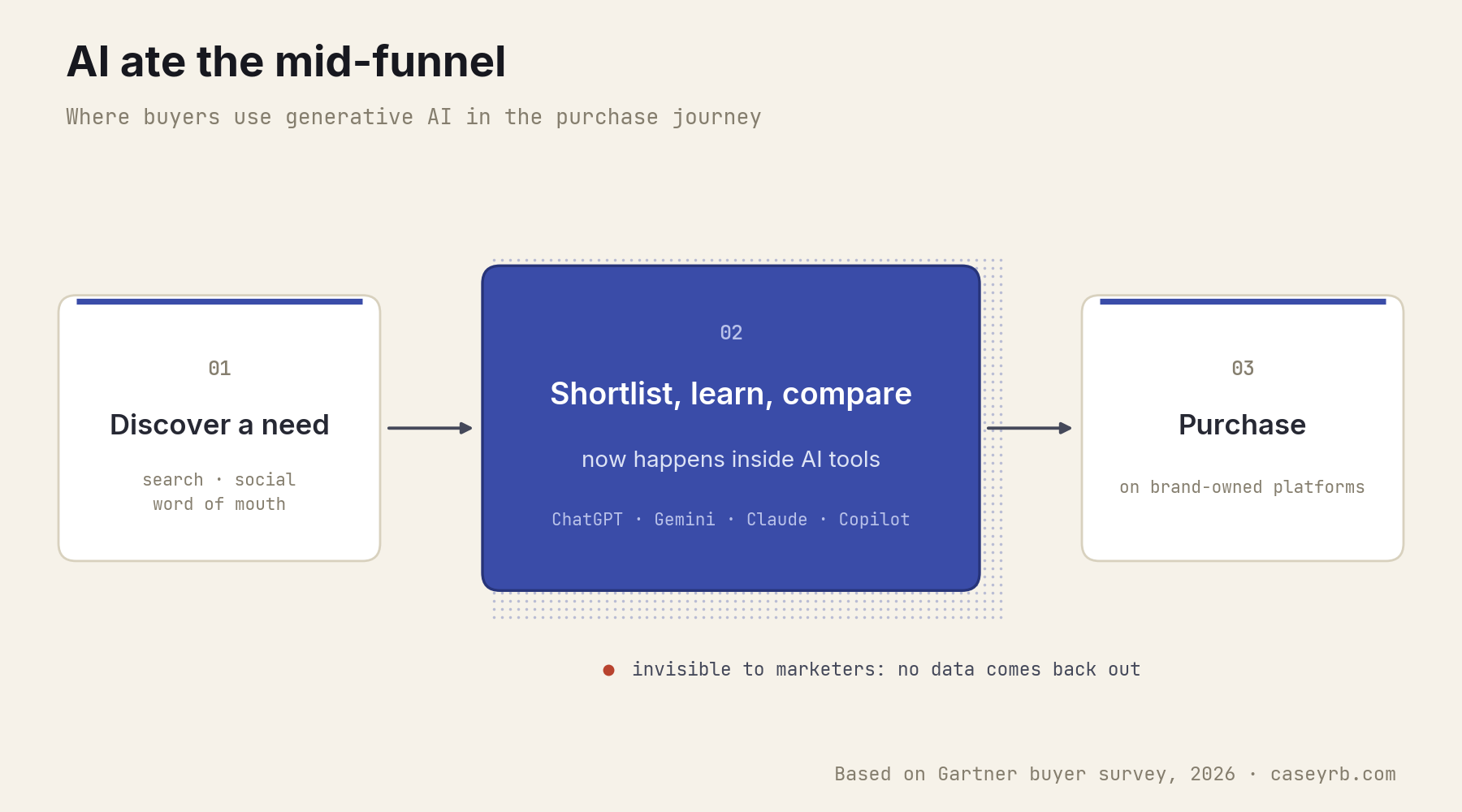
That specificity is a gift. It tells you exactly which content the answer engines are retrieving on your buyers’ behalf: comparison content, evaluation content, “which option fits my situation” content.
This matches what I see day to day building out exactly this comparison layer at GravityKit. The blog post optimized for a top-of-funnel keyword is a depreciating asset. The honest, structured comparison page is what both the models and the humans reach for at the moment that matters. My 7 pillars of GEO framework covers the retrieval fundamentals.
One warning from the Q&A: stale content is now a liability. If you have product-specific pages that nobody visits and nobody maintains, a model can still retrieve them and confidently serve outdated information about your own product, cannibalizing the correct answer. An unmaintained archive used to be harmless. Now it’s a misinformation vector with your name on it. Audit it or remove it.
Trust is the asset AI can’t take
Now for the good news. Gartner found that 76% of buyers report high trust in brand-provided digital information. And in their long-running trust tracking, trust in brands has risen sharply over the past two years, the exact period in which AI usage exploded. Correlation isn’t causality, but the direction is striking: as the information environment filled with synthetic answers, the branded source became more credible, not less.
In your market, you will almost always command more trust than any answer engine. That’s the asset. And it maps neatly onto the three reasons buyers over-rely on AI in the first place: they want to go fast, they feel overwhelmed by the decision, or they believe the AI decides better than they can. Each one is something a brand can interrupt:
- Slow the buyer down at the right moment. Not with friction, but with a question they hadn’t considered. TD Bank’s financial health assessment asks about things like wills, which no answer engine brings up unprompted, precisely because the buyer didn’t ask.
- Simplify the decision honestly. Reduce the option set, name the two or three parameters that actually matter, and say plainly which product fits which situation, including when the answer is “not ours.” That’s the comparison layer again, doing double duty: it feeds the answer engines and it rebuilds the buyer’s own judgment.
- Confront misinformation directly. Some pharmaceutical companies run public misinformation hubs that refute AI-generated claims about their products by name. Most software companies will never need something that heavy, but the principle scales down: correct the record on your own site, visibly, because the models are reading it.
To be clear, none of this is anti-AI. You can’t out-argue your buyers’ tools, and you shouldn’t try. The play is to be the most retrievable source when the AI answers, and the most useful interruption when the buyer is about to outsource a decision they should own.
What I’d actually do
Here’s what I’d prioritize for a software company:
- Now: get the retrieval fundamentals right: structured data, current content, consistent terminology. Then audit your mid-funnel content against the questions buyers actually ask at the shortlist and compare stages, and fill the gaps. While you’re in there, retire the stale pages before they misinform on your behalf.
- Next 90 days: find the two or three moments where your buyers are most likely to hand the decision to AI, and build something that interrupts them: an honest comparison page, a decision-making tool, a fit-finder. At GravityKit we built an AI product recommender for exactly this moment in the journey.
- Next 12 months: instrument what’s still observable. AI referral traffic, citation monitoring, and the conversion behavior of AI-referred visitors, who in my experience behave differently from search traffic once they land. The mindset shift is to measure rather than attribute. That distinction deserves a post of its own, and I’m working on it.
The funnel didn’t collapse. It moved. The middle of it now lives somewhere you can’t see and can’t buy your way into. What’s left is the part you were always supposed to be best at: being the most trustworthy source of truth about your own product.
Can your marketing still see what it’s optimizing? And when your buyer asks ChatGPT whether to choose you, do you know what it says?