
In September, after a decade of charging for the nomads.com community (most recently $99 to join), Pieter Levels made it free, apart from a $1 sign-up fee to keep spam out. He has also launched a paid API that sells the city data his members create, at $2,490 to $9,990 a year.
Levels is one of the best-known indie hackers around, and this is his second big shift in four years. In late 2022 he moved from remote work into AI apps. Now, in a post titled I’m scrambling to chase any remaining moats as AI companies suck up everything else, he has gone through every site and app he runs and asked which parts AI can’t take from him.
The money at nomads.com has moved from access to the community to what the community produces. I’ve been writing about the same kind of shift in WordPress for most of this year, and Levels’s move is the clearest example I’ve seen of where value goes when AI can copy almost anything.
Anything that can be described can be copied
Peter Diamandis made the general case in What counts as a moat in the age of AI? The classic moats (patents, proprietary technology, network effects, switching costs and brand) all assumed that copying a business was slow and expensive. A competitor had to hire engineers and rebuild the product, and that took years. In Diamandis’s words, “AI collapses time and effort.”
His summary: “Everything that can be described can be copied, and AI can describe anything.” He applies it even to Nvidia’s CUDA, since a frontier model can now take code written for Nvidia chips and make it run fast on AMD’s.
Levels ran into this himself. On September 4, he wrote that he’d tried for weeks to build his own ScrapingBee, a paid web scraping service, and his AI tools kept telling him they couldn’t do it. Five days later he’d vibe coded a replacement that works about 90% of the time and costs him roughly a dollar a month.
I had my own version of this yesterday. In a day, I built Behindsight, an agent skill that reverse-engineers a company’s marketing from its public website. Give it a domain, and 20 to 30 minutes later you have a comprehensive report on the company’s positioning, funnel, ads, content and marketing stack.
The usual objections to vibe coding are that the code isn’t secure and nobody can maintain it. Those are fair today, but they assume the tools stay where they are. Five days from “can’t be done” to done is a good measure of how fast that’s changing.
Where the value goes
Diamandis closes with a test: “If AI could copy everything you’ve built in ninety days, what would you still have? Whatever your answer is, that’s your actual moat.”
Between them, Levels and Diamandis give a fairly complete answer:
- Data that people create. This is first on Levels’s list, and nomads.com shows how it works. Members review cities after they visit and flag which places are growing or shrinking. That record is what the API sells to real estate, coworking and gym investors. Levels also reported that data brokers are buying SaaS datasets for $100,000 to $2 million and reselling them to AI labs.
- Community and an audience you own. Making nomads.com free grows the source of that data. In his post about the change, Levels wrote that the community got about 50 new members a month at $299, 200 at $99 and 400 at $29. He also has 187,279 people on email and Telegram, so he isn’t renting all of his reach from X.
- Things in the physical world. Levels is growing nomads.com meetups, working on a hotel booking site and building a 1990s-style retro PC to sell as hardware.
- Capital. For Diamandis, the hyperscalers’ real advantage is that they can pay for hundreds of billions of dollars of GPUs out of cash flow. Levels is looking to buy land and is investing in startups.
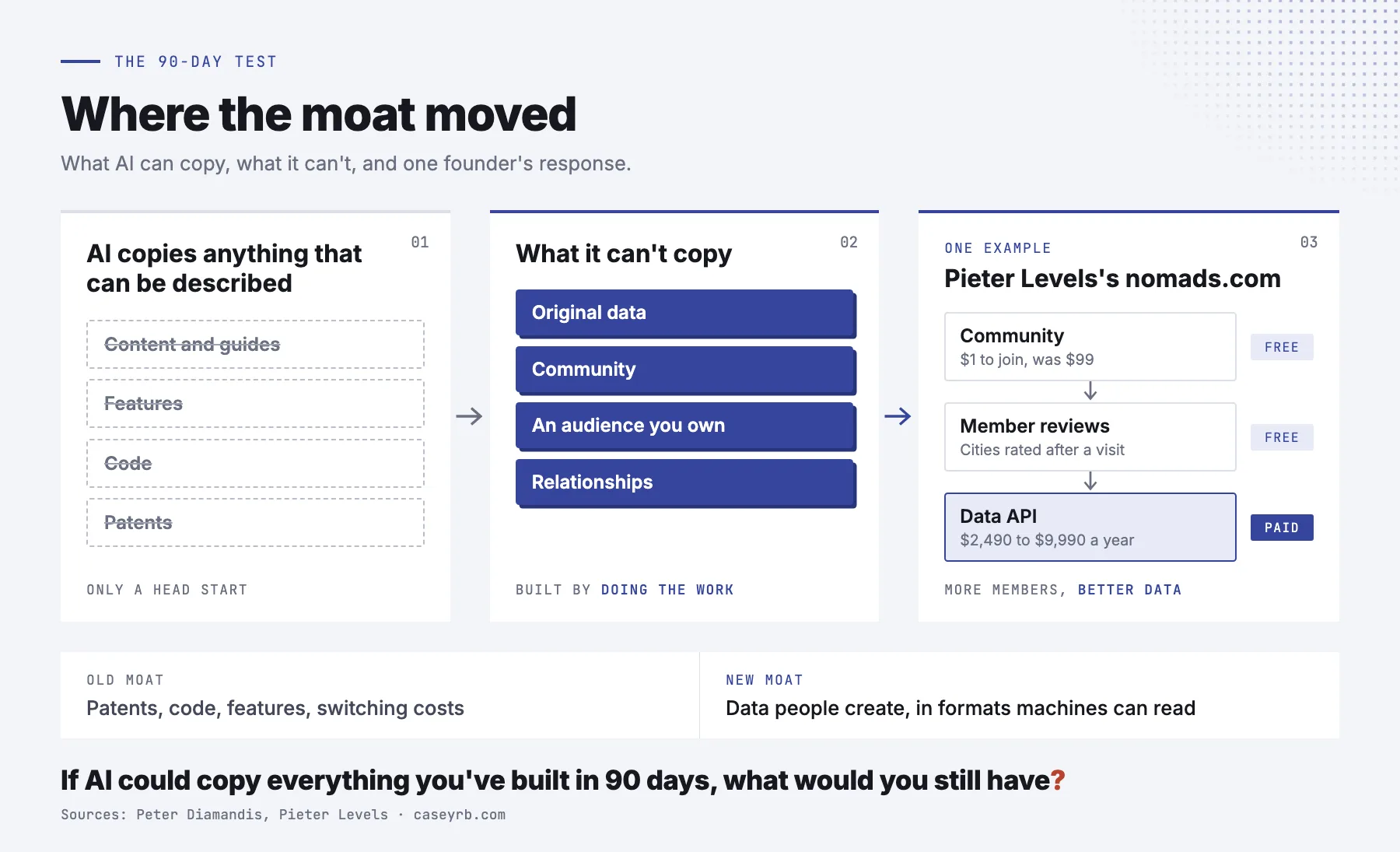
A coding agent could clone the nomads.com website in a weekend. It couldn’t recreate a decade of reviews, because those only exist when people take part.
WordPress got there first
WordPress product companies have never had a code moat. Plugins are released under the GPL, so anyone can legally copy and redistribute the code. What customers paid for was support and updates.
AI is now eroding both. Earlier this year I asked what plugin licenses are actually paying for when customers paste their errors into ChatGPT instead of filing a ticket, and coding agents can extend a plugin in minutes.
The answer many companies have landed on looks a lot like Levels’s. In the SaaSification of WordPress, I went through plugin companies adding hosted services, usage credits and standalone SaaS products. Each one moves the core logic and the customer’s data behind an API, where AI can’t inspect or copy it. The plugin becomes the free, copyable part, and the service behind it is what customers pay for.
Speed of reinvention
First on Diamandis’s own list is speed of reinvention: “The durable advantage is the metabolic rate of the organization, and AI is the fastest way to raise it.”
His example is Jensen Huang. Nvidia bought Mellanox for $7 billion in 2019 to own the networking that lets 100,000 or more GPUs run as one machine, long before anyone was porting CUDA code with a prompt. Dave Blundin, who co-hosts Diamandis’s Moonshots podcast, summed it up: “Your moat is only good until the next moat.” Diamandis’s advice to founders is to stop pitching their moat and show investors the pivots they’ve made in the past 12 months instead.
I’d go further. AI lowers the cost of building, so the bar for what’s worth building goes up. If a paid service can be replaced in five days, a roadmap that ships one modest feature a quarter is aiming too low. In the plugin licenses post I wrote that releasing an update every few months and calling it a day is no longer enough. The same applies to any product.
Levels is the example again. He’s one person, and alongside a data API he’s working on a hotel booking site and building his own hardware. That’s the kind of ambition cheap building makes possible.
So ask Diamandis’s question about your own product: if AI could copy everything you’ve built in 90 days, what would you still have? Then ask the harder one: with the same tools, what could you build in the next 90 days that you wouldn’t have attempted a year ago?